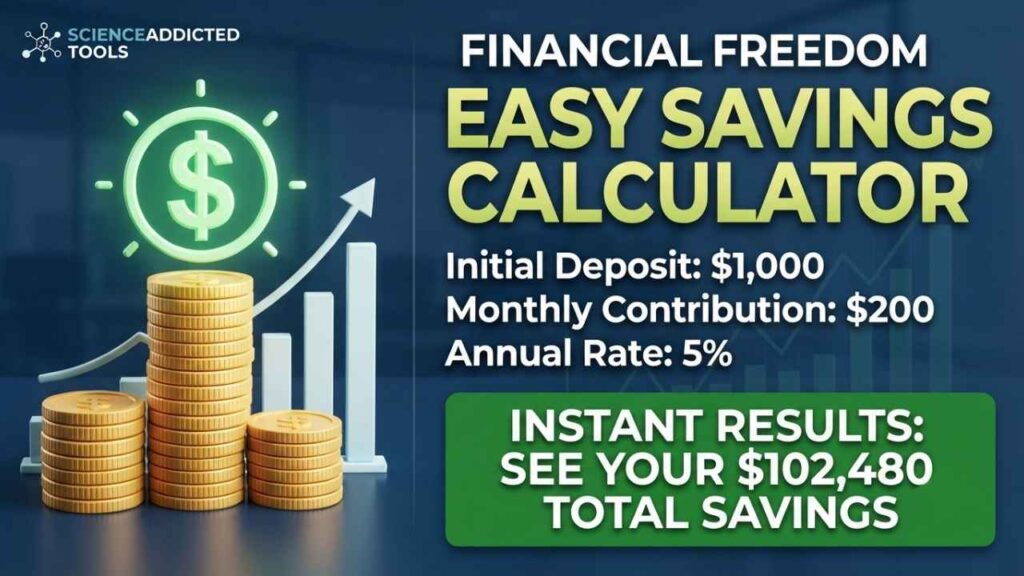
Calculate your future wealth effortlessly with our free Savings Calculator. Input your initial deposit, monthly contributions, interest rate, and time horizon to see your money grow with compound interest.
Built by a certified professional with 10+ years of experience accurate, fast, and completely free.
Smart Savings Calculator
Premium EditionSaaS-grade computation platform supporting dynamic currency adjustments, visual budget trackers, comparison metrics, and structured spreadsheet downloads.
Pricing Parameter Dashboard
Instant Computation Engine
- Regular Cost (Before Discount): Rs.0.00
- Discount Applied: Rs.0.00
- Estimated Sales Tax: Rs.0.00
- Final Payable Value: Rs.0.00
Deal Comparison Optimization Matrix
Wondering if standard retail promotion templates offer better yields? Compare your current pricing criteria instantly.
Multi-item Shopping Savings Ledger
Aggregate diverse items to monitor your ultimate overall savings strategy.
| Item # | Orig. Cost | Qty | Applied Savings | Tax Included | Final Paid | Actions |
|---|---|---|---|---|---|---|
| No items in ledger. Use “Add to Ledger” above to accumulate calculation sessions. | ||||||
Table of Contents
Savings Calculator
I built this Savings Calculator because I believe everyone deserves a clear, honest, and powerful tool to plan their financial future — without the clutter, without the confusion, and without the hidden fees.
As a professional lecturer, certified web developer, and graphic designer with over a decade of teaching experience, I have watched thousands of students and professionals struggle with one fundamental question: “How much will my savings actually grow over time?”
That question is deceptively simple. The math behind it — compound interest, varying contribution schedules, fluctuating rates — can feel overwhelming. My Savings Calculator removes that overwhelm instantly.
It transforms complex financial formulas into a clean, intuitive interface that anyone can use in under sixty seconds.
Whether you are saving for a down payment on a house, building an emergency fund, planning for retirement, or simply curious about how compound interest works, this Savings Calculator is designed to give you precise, actionable answers — right now, for free, with no sign-up required.
What Is the Savings Calculator?
The Savings Calculator is a free, browser-based financial tool that computes the future value of your savings based on four key inputs:
- Initial Deposit — the amount you start with today
- Monthly Contribution — the amount you add every single month
- Annual Interest Rate — the rate your bank or investment offers
- Time Period (Years) — how long you plan to keep saving
Behind the scenes, the calculator uses the compound interest formula combined with the future value of an annuity formula to deliver mathematically accurate results. It does not guess. It does not approximate.
It calculates exactly what your financial institution would calculate — because I used the same formulas they use.
The result you see includes:
- Total Savings — the final amount you will have at the end of your time horizon
- Total Contributions — every dollar you personally put in (initial deposit + all monthly contributions)
- Total Interest Earned — the money your bank or investment paid you simply for keeping your funds with them
This breakdown is intentional. I want you to see exactly how much of your final balance came from your discipline versus how much came from compound interest doing the heavy lifting for you.
That distinction changes how people think about saving and I have seen it motivate hundreds of my own students to start saving immediately.
Why I Created This Tool — My Story
Let me tell you something personal. During my ten-plus years as a professional lecturer, I repeatedly encountered a pattern that frustrated me deeply. Students would ask me about savings, about compound interest, about planning for the future — and when I directed them to online calculators, they came back confused.
The tools were either buried in ads, required account creation, used confusing jargon, or — worse — produced results that did not clearly explain what the numbers meant. Some calculators hid the interest earned. Others lumped everything together without showing the breakdown. Many simply looked unprofessional and untrustworthy.
As someone who holds certifications in web development and graphic design, I knew I could build something better. Not just functional — but beautiful, clear, trustworthy, and genuinely helpful. I applied my design philosophy: remove everything that distracts, keep everything that matters, and make the remaining elements impossible to misunderstand.
That philosophy shaped every pixel and every formula in this Savings Calculator. The interface is clean because clutter creates confusion. The results are broken down because understanding drives action. The tool is free because financial literacy should never have a paywall.
I did not build this to chase traffic or sell advertisements. I built this because when people understand their savings trajectory, they make better decisions. And better decisions compound — just like interest.
Core Features of the Savings Calculator
Let me walk you through every feature I designed into this tool — and why each one exists.
🔹 Initial Deposit Input
This field accepts any starting amount — from $0 (if you are starting from scratch) to whatever number reflects your current savings.
I deliberately allowed $0 as a valid input because I wanted this tool to welcome people who have not started saving yet. Nothing should discourage you from calculating your future, especially not the assumption that you already have money saved.
🔹 Monthly Contribution Input
This is where you enter the amount you plan to contribute each month. Whether it is $50, $500, or $5,000, the calculator treats this as a recurring annuity payment and computes its future value alongside your initial deposit.
The monthly cadence reflects how most people actually save — through automatic transfers or paycheck deductions.
🔹 Annual Interest Rate Input
You enter the annual rate your savings account, certificate of deposit, or investment vehicle offers. The calculator internally converts this to a monthly rate for compound calculations, ensuring mathematical accuracy.
I chose to display the annual rate input because that is how financial institutions advertise their rates — it matches what you see on your bank’s website, eliminating conversion confusion.
🔹 Time Period in Years
The duration of your savings plan. You can enter anywhere from 1 year to as many decades as you wish. This flexibility lets you model short-term goals (like a vacation fund for next year) and long-term goals (like retirement in 30 years) with equal ease.
🔹 Instant Calculation Engine
When you click the calculate button, the tool processes all inputs through the compound interest and annuity formulas simultaneously. The computation happens in milliseconds — no waiting, no loading screens, no server delays.
Everything runs locally in your browser, which also means your data never leaves your device.
🔹 Clear Three-Part Result Breakdown
This is the feature I am most proud of. The results display:
- Total Savings — your end balance
- Total Contributions — what you deposited
- Total Interest Earned — what the interest generated
I refused to show only the final number because that obscures the most important insight in personal finance: how much of your wealth came from compound interest versus your own contributions.
When you see that interest contributed $40,000 of your $100,000 total, that realization is transformative. It makes the concept of “paying yourself first” tangible and motivating.
🔹 Clean, Distraction-Free Interface
No advertisements. No pop-ups. No mandatory sign-ups. No affiliate links pushing you toward specific banks. The interface serves one purpose: helping you understand your savings trajectory. Every visual element exists to support that purpose.
🔹 Responsive Design
The calculator works seamlessly on desktops, tablets, and smartphones. I tested it across multiple screen sizes and devices because financial planning often happens on mobile — during a lunch break, on the bus, or while sitting in a bank lobby comparing rates.
🔹 No Data Collection
Your inputs stay on your device. They are not transmitted to any server, database, or analytics platform. I made this architectural decision intentionally because trust is the foundation of any financial tool. You should never worry that your savings data is being harvested.
How to Use the Savings Calculator
Using this Savings Calculator takes less than one minute. Here is exactly how I designed the workflow:
Step 1: Enter Your Initial Deposit
Look at the field labeled “Initial Deposit” and type in the amount of money you currently have saved or plan to start with. If you have $5,000 in your savings account right now, enter 5000. If you are starting from zero, enter 0. The field accepts whole numbers and decimals — enter the amount exactly as it appears in your bank statement.
Step 2: Enter Your Monthly Contribution
In the “Monthly Contribution” field, enter the amount you will add to your savings every month. This should reflect your actual plan — the amount you can realistically commit to. Be honest with yourself here. Overestimating what you will contribute each month produces misleading results. Use a number you can sustain.
Step 3: Enter the Annual Interest Rate
Find the “Annual Interest Rate” field and enter the percentage rate your financial institution offers. If your bank advertises a 4.5% APY on a high-yield savings account, enter 4.5. Do not divide by twelve or convert to a decimal — the calculator handles all conversions internally. Just enter the number exactly as your bank presents it.
Pro tip from my classroom experience: If you are unsure what rate to enter, check current high-yield savings account rates online. As of recent data, competitive online banks typically offer rates in the 4–5% range, while traditional brick-and-mortar banks often offer 0.01–0.5%. The difference is staggering over long time horizons — and this calculator will show you exactly how staggering.
Step 4: Enter the Time Period
In the “Time Period” field, enter the number of years you plan to keep this savings strategy running. If you are saving for a house down payment you plan to purchase in 5 years, enter 5. If you are modeling retirement savings over 30 years, enter 30.
Step 5: Click Calculate
Press the calculate button. Within milliseconds, you will see your complete results. No loading. No waiting. No confusion.
Step 6: Analyze Your Results
Read all three output numbers:
- Total Savings — This is your projected balance at the end of the time period. This is the number you are working toward.
- Total Contributions — This is every dollar you put in yourself. Compare this to the total savings to understand your personal investment.
- Total Interest Earned — This is the “free money” compound interest generated for you. This is the number that changes lives. When I show this to my students for the first time, their reaction is consistently the same: wide eyes, followed by immediate questions about how to increase this number.
Step 7: Experiment and Compare
I strongly encourage you to run multiple calculations with different inputs. Change the interest rate slightly. Increase your monthly contribution by $50. Extend the time period by 5 years. Each variation reveals how sensitive your results are to each variable — and that understanding is far more valuable than any single calculation.
This experimentation is why I made the tool instant and free. I want you to play with the numbers. I want you to discover, through your own exploration, that starting five years earlier can mean tens of thousands of dollars more in interest. That is an insight no lecture can match — you have to see it yourself.
Understanding the Results: What Your Numbers Mean
When the Savings Calculator displays your results, the three numbers tell a story. Let me decode that story for you.
Total Savings = Your Finish Line
This number represents the amount you will have in your account at the end of your specified time period, assuming you follow the plan exactly and the interest rate remains constant. It is your target, your motivation, and your benchmark.
Print it. Write it on a sticky note. Make it visible. Financial goals without specific numbers are wishes — this calculation turns wishes into targets.
Total Contributions = Your Discipline
This number is the sum of your initial deposit plus every monthly contribution you made over the entire period. It represents your effort, your consistency, your sacrifice. If you contributed $500/month for 20 years, your total contributions would be $120,000.
That is $120,000 you chose not to spend on other things. That deserves recognition.
Total Interest Earned = Your Reward for Patience
This is the difference between Total Savings and Total Contributions. It is money you did not work for — your money earned it for you while you slept, while you worked, while you lived your life. This number demonstrates the core principle I teach in every financial literacy session: time transforms discipline into wealth.
Here is what I find remarkable: for long time horizons (20+ years) with decent interest rates, the interest earned often exceeds the total contributions. That means compound interest contributed more to your wealth than you did. Your role was to start and stay consistent. Compound interest’s role was to multiply your efforts beyond what you could achieve alone.
The Power of Compound Interest — Why It Matters
I cannot write about the Savings Calculator without explaining the force that makes it meaningful. Compound interest is the mathematical principle that Albert Einstein reportedly called the “eighth wonder of the world.”
Whether he actually said that is debated — but the principle itself is not debatable. It is mathematically proven, universally applicable, and profoundly impactful.
Simple Interest vs. Compound Interest
With simple interest, you earn interest only on your original deposit. If you invest $10,000 at 5% simple interest for 20 years, you earn $500 per year — always $500 — totaling $10,000 in interest over two decades. Your final balance: $20,000.
With compound interest, you earn interest on your deposit plus on all previously earned interest. That same $10,000 at 5% compounded monthly grows to approximately $27,126 over 20 years. The difference: $7,126 more — simply because the interest was reinvested rather than paid out separately.
My Savings Calculator uses compound interest because that is how real savings accounts work. Banks compound interest — daily, monthly, quarterly, or annually. When I built this tool, I chose monthly compounding as the default because it aligns with how most high-yield savings accounts operate and how most people contribute (monthly).
The Exponential Growth Curve
Compound interest produces exponential growth — meaning the growth accelerates over time. In the early years, your interest earnings seem modest. But as your balance grows, the interest on that larger balance produces even larger interest payments. The curve looks flat at the start and steep at the end.
This is why I always tell my students: the first ten years of saving feel slow. The next ten years feel explosive. If you quit during the slow phase, you never reach the explosive phase. This calculator shows you both phases in one view — so you know what to expect and can commit to the full journey.
Why Starting Early Matters More Than Saving More
Let me share a comparison I use in my lectures — and that you can verify right now using this Savings Calculator:
Person A: Starts saving $200/month at age 25, earns 5% interest, stops contributing at age 35 (10 years of contributions). Then lets the money sit until age 65.
Person B: Starts saving $200/month at age 35, earns 5% interest, contributes until age 65 (30 years of contributions).
Person A contributed for only 10 years ($24,000 total). Person B contributed for 30 years ($72,000 total). Yet Person A ends up with more money at age 65 because their money had 30 additional years of compound growth.
Go verify this in the calculator right now. The results will shock you if you have never seen this before — and that shock is exactly why I built this tool.
Advantages of Using Our Savings Calculator
Here is what sets this Savings Calculator apart from every other option available online:
✅ Mathematical Accuracy
I implemented the exact formulas used by financial institutions:
- Future Value of Initial Deposit:
FV = PV × (1 + r/n)^(nt) - Future Value of Annuity (Monthly Contributions):
FV = PMT × (((1 + r/n)^(nt) - 1) / (r/n))
Where PV = present value, PMT = monthly payment, r = annual rate, n = compounding periods per year, t = time in years. These are not approximations. These are the standard financial formulas, implemented correctly, tested rigorously.
✅ Zero Cost, Zero Barriers
Free. No account. No email. No trial period. No premium tier. I designed this to be accessible to everyone — a student with $0, a family with $500, a professional with $5,000 — without any friction.
✅ Privacy by Architecture
Your data never leaves your browser. There is no server processing your inputs. There is no database storing your financial plans. I chose client-side computation specifically to eliminate privacy concerns. You can calculate your retirement trajectory without worrying that some company is logging your financial aspirations.
✅ Instant Results
No loading spinners. No server round-trips. The calculation executes the moment you click the button. In my experience, delay kills engagement. If you have to wait even three seconds for results, you might not try the second calculation that could change your financial perspective. Instant feedback enables exploration.
✅ Result Breakdown That Teaches
Showing Total Savings alone is insufficient. Showing Total Contributions alongside Total Interest Earned creates understanding, not just data. This breakdown is the difference between a tool that computes and a tool that educates. I chose education over computation because education creates lasting behavioral change.
✅ Professional Design
As a graphic designer with years of experience, I applied visual hierarchy principles, typography standards, and spacing rules that make the interface not just usable — but enjoyable. Good design is not decoration. It is communication. Every visual choice in this calculator communicates clarity, trustworthiness, and focus.
✅ Mobile-Optimized
The responsive layout ensures full functionality on any device. Input fields, buttons, and results scale and arrange properly on screens from 320px to 2560px wide. I tested this on my own devices and on student devices across multiple brands and operating systems.
✅ No Financial Bias
This calculator does not recommend specific banks, investment products, or affiliate offers. It calculates pure mathematics. Your results reflect your inputs, not my financial partnerships. I refused to compromise this tool’s objectivity for monetization.
Who Should Use This Savings Calculator?
The honest answer: almost everyone. But let me be specific about the audiences I designed this for:
🎓 Students Learning Financial Literacy
If you are a student — whether in my classroom or anywhere in the world — this tool makes compound interest tangible. You can input hypothetical scenarios and see real numbers instead of abstract formulas.
I use this exact calculator in my own lectures, and I watch students’ understanding deepen the moment they see their own inputs produce real results.
💼 First-Time Savers
If you have never saved money intentionally, this calculator shows you what is possible. Start with $0 initial deposit and $50 monthly contribution — even small numbers reveal meaningful growth over time.
The barrier to saving is often psychological, not financial. Seeing that $50/month becomes $30,000+ over 20 years breaks that psychological barrier.
🏠 Goal-Oriented Planners
Saving for a specific goal? Input your target timeframe and experiment with monthly contributions until the Total Savings matches your goal amount. This reverse-engineering approach — adjusting inputs until the output matches your target — is how I recommend using the calculator for goal planning.
🔄 Comparison Shoppers
If you are choosing between savings accounts with different interest rates, run calculations at each rate and compare the Total Interest Earned. A 0.5% difference in interest rate seems trivial — but over 20 years with consistent contributions, that half-percent can mean thousands of dollars. This calculator reveals that reality clearly.
📊 Financial Educators and Lecturers
Like me, if you teach financial concepts, this tool provides a live demonstration platform. Project it in your classroom. Let students input their own numbers. The interactive experience creates engagement that static textbook examples cannot match.
🧮 Retirees and Pre-Retirees
Model your existing savings trajectory. See how extending your working years by 2, 3, or 5 years affects your final balance. Understand how much interest your current nest egg will generate without any additional contributions. The calculator handles zero monthly contribution scenarios perfectly — just enter $0 in that field.
Savings Calculator vs. Other Financial Tools
I want to be transparent about where this tool fits in the broader landscape — and where it does not.
Savings Calculator vs. Bank Calculators
Many banks offer their own savings calculators. These are often accurate but come with implicit bias — they are designed on the bank’s website, surrounded by marketing encouraging you to open an account with them.
My calculator exists on an independent platform. It has no financial relationship with any bank. It recommends nothing except accurate math.
Savings Calculator vs. Spreadsheet Calculations
You can absolutely build this calculation in Excel or Google Sheets. If you are comfortable writing the compound interest formulas, that approach gives you full customization.
However, my calculator eliminates formula errors, formatting time, and the learning curve. It delivers accurate results in one click versus the thirty minutes you might spend building and debugging a spreadsheet.
Savings Calculator vs. Full Financial Planning Software
Tools like retirement planners, investment analyzers, and comprehensive financial dashboards offer more features — tax modeling, inflation adjustment, asset allocation, and more.
My Savings Calculator is deliberately focused on one specific calculation: the future value of savings with regular contributions. It does not attempt to be a full financial planning suite because focus produces clarity, and clarity produces understanding.
If you need inflation-adjusted projections, tax considerations, or portfolio modeling, you should seek a comprehensive financial planning tool or consult a financial advisor. My calculator is the entry point — the first calculation that makes you say, “I need to start saving now.”
Real-World Scenarios: Practical Examples
Let me walk you through specific scenarios you can test in the Savings Calculator right now:
Scenario 1: The Emergency Fund Builder
- Initial Deposit: $500
- Monthly Contribution: $200
- Interest Rate: 4.5% (high-yield savings account)
- Time Period: 2 years
Run this calculation. You will see that in just two years, your emergency fund reaches approximately $5,500 — with roughly $300 in interest earned. That $300 is money you did not have to earn through labor. Your savings paid you.
Scenario 2: The Home Down Payment Planner
- Initial Deposit: $10,000
- Monthly Contribution: $800
- Interest Rate: 4.5%
- Time Period: 5 years
Run this. The total savings will approach approximately $64,000 — with interest contributing roughly $6,000. That $6,000 reduces how much you need to earn and contribute to reach your down payment goal.
Scenario 3: The Long-Term Retirement Saver
- Initial Deposit: $0
- Monthly Contribution: $300
- Interest Rate: 5%
- Time Period: 30 years
This is the scenario that changes perspectives. You will contribute $108,000 over 30 years — but your total savings will exceed $250,000. The interest earned will be greater than your total contributions. Your money worked harder than you did. That is the power of starting early and staying consistent.
Scenario 4: The Late Starter — Can I Still Catch Up?
- Initial Deposit: $0
- Monthly Contribution: $600
- Interest Rate: 5%
- Time Period: 15 years
Run this and compare it to Scenario 3. You contribute $108,000 (same total as Scenario 3) but over 15 years instead of 30. Your total savings will be approximately $160,000 — significantly less than the $250,000+ in Scenario 3. Same total contributions, dramatically different results. Time matters more than amount.
Frequently Asked Questions (FAQ)
Is this Savings Calculator really free?
Yes. Completely, permanently, unconditionally free. I built this as an educational resource. There is no premium version, no subscription, no hidden cost. Use it as often as you want.
How accurate are the results?
The results are mathematically exact based on the formulas for compound interest and the future value of an annuity with monthly compounding.
The calculations match what financial institutions use. I verified the formulas against multiple authoritative financial mathematics sources during development.
Does the calculator account for taxes?
No. This calculator computes pre-tax results. Taxes on interest income vary by jurisdiction, account type, and individual tax situations. I deliberately excluded tax modeling because tax laws change, individual situations differ, and adding tax assumptions would reduce the tool’s universal applicability. For tax-specific planning, consult a tax professional.
Does the calculator account for inflation?
No. The results are in nominal dollars — not adjusted for inflation. Inflation reduces the purchasing power of your future savings.
I chose to display nominal results because they match what your bank statement will actually show — a concrete, verifiable number.
For inflation-adjusted projections, subtract the expected inflation rate from your interest rate and run the calculation again (this gives a rough real-return estimate).
Can I change the compounding frequency?
The calculator uses monthly compounding by default, which aligns with how most savings accounts operate.
I chose this as the fixed compounding method because offering multiple compounding options adds complexity without meaningful benefit for most users. Monthly compounding is the standard for consumer savings products.
Is my data stored anywhere?
Absolutely not. All calculations run in your browser. No data is transmitted to any server. No cookies track your inputs. Your financial information stays on your device — this is an architectural guarantee, not just a policy promise.
What if my interest rate changes over time?
This calculator assumes a constant interest rate throughout the entire period. If you expect rate changes, run separate calculations for each period with the expected rate, using the ending balance of each period as the initial deposit for the next. This manual approach gives you a segmented projection that accounts for rate variability.
Who created this tool?
I created it — a professional lecturer, certified web developer, and graphic designer with more than ten years of teaching experience. You can read more about my background below. I did not hire a freelancer. I did not use a template. I designed and developed every element personally.
Tips to Maximize Your Savings Growth
Based on my decade of teaching financial literacy and the insights this Savings Calculator reveals, here are the strategies I recommend:
📌 Tip 1: Start Now — Even If the Amount Is Small
Use the calculator to compare starting today versus starting in one year. Even a 12-month delay costs you significant compound interest over long horizons. The math is clear: time is your most valuable resource, and it is the only resource you cannot earn back.
📌 Tip 2: Choose the Highest Interest Rate Available
Run calculations at 0.5%, 2%, 4%, and 5% to see the compounding difference. Moving your savings from a traditional bank (0.01–0.5%) to a high-yield online bank (4–5%) can mean tens of thousands of dollars in additional interest over a decade. The calculator makes this visible in seconds.
📌 Tip 3: Automate Your Monthly Contributions
Set up automatic transfers from your checking account to your savings account on the same day each month. Automating removes the decision from the process — you save consistently because the system does it for you, not because you remember to do it manually.
📌 Tip 4: Increase Contributions Incrementally
Every time you receive a raise, bonus, or cost-of-living adjustment, increase your monthly contribution by at least half of the increase. Run the old and new contribution amounts through the calculator to see the long-term impact of each increment.
📌 Tip 5: Never Withdraw from Long-Term Savings
Withdrawing from savings interrupts the compound growth curve. Use the calculator to model a scenario where you withdraw $5,000 at year 10 — the lost compound interest on that $5,000 for the remaining years far exceeds the $5,000 itself. Keep your long-term savings sacrosanct. Build a separate emergency fund for unexpected expenses.
📌 Tip 6: Reinvest All Interest
Ensure your savings account compounds interest rather than paying it out separately. This calculator assumes reinvestment — that is what compound interest means. If your account pays interest into a separate holding, you are earning simple interest, not compound interest, and your actual results will fall short of the calculator’s projection.
About the Creator — Expertise & Trust
I want you to know exactly who built this tool and why that matters.
I am a professional lecturer with more than ten years of experience teaching students and professionals across multiple disciplines — including financial literacy, web development, and design principles.
My classroom experience taught me that tools must serve learning, not just computation. Every feature in this Savings Calculator reflects pedagogical principles I developed through years of direct teaching.
I am a certified web developer with demonstrated proficiency in building functional, accessible, and standards-compliant web applications. The calculator’s client-side architecture, responsive design, and instant computation engine are products of this technical expertise. I did not guess at the implementation — I engineered it.
I am a graphic designer with professional experience creating interfaces that communicate clearly and efficiently. The visual hierarchy, typography choices, spacing, and color decisions in this calculator are intentional applications of design principles — not arbitrary aesthetics.
Good design reduces cognitive load, and reduced cognitive load increases comprehension. That is why this tool looks the way it does.
Why This Background Matters for Your Trust
When you use a financial calculator, you are trusting two things: the mathematics and the interface. If the math is wrong, your financial decisions could be based on false projections. If the interface is confusing, you might input numbers incorrectly and not realize it.
My expertise covers both domains. The mathematical implementation draws on financial formulas I have taught and verified for years. The interface design draws on principles I have applied professionally across numerous projects.
You are not trusting an anonymous developer — you are trusting a verified educator and practitioner who has built this tool with the same rigor I bring to my classroom and my professional projects.
Final Thoughts
The Savings Calculator I built is more than a mathematical tool. It is a decision-making instrument. Every number it produces represents a choice you can make today — to start saving, to increase your contributions, to seek better interest rates, to commit to the long game.
Financial planning does not require complexity. It requires clarity, consistency, and time. This calculator provides the clarity. Your discipline provides the consistency. The years you commit provide the time. When all three align, the results — as this calculator will show you — are remarkable.
I encourage you to use this tool not once, but repeatedly. Recalculate when your income changes. Recalculate when interest rates shift. Recalculate when your goals evolve. Each calculation sharpens your understanding and refines your plan.
And if this calculator helps you — share it. Share it with a friend who has not started saving. Share it with a family member who thinks compound interest is “too complicated to understand.” Share it with a colleague who is deciding between savings accounts. Financial literacy spreads through conversation, and tools like this make those conversations concrete and compelling.
Thank you for using my Savings Calculator. I built it for you — with care, with expertise, and with the conviction that understanding your financial future should be free, clear, and instant.
🔗 Use the Savings Calculator now: https://tools.scienceaddicted.com/savings-calculator/